Hello!
I’m Spiro, an illustrator.
If you’re an individual who’s thinking about becoming a VTuber, you may be wondering:
What kind of materials should I prepare?
How much should I decide in advance?
What information does the artist need from me?
You do not need to prepare a perfect design brief from the very beginning.
As long as you can communicate your main ideas clearly and leave some room for the artist to use their expertise, the production process will usually go much more smoothly for everyone involved.
1. First, Clarify What You Want to Commission
VTuber production usually involves several different stages:
- Character design
- Live2D model art
- Live2D rigging
These are generally separate types of work.
Before contacting an artist, check which parts of the production process they can handle, and decide which parts you would like to commission.
For example, there is a big difference between:
I need both the character design and the Live2D-ready PSD.
and:
My character design is already complete, and I only need the Live2D model art.
The amount of work, production time, and price will vary depending on the scope.
2. You Do Not Need to Decide Every Detail in Advance
Your VTuber character may become an important part of your identity, so it is completely understandable to have strong ideas about their hairstyle, clothing, colors, accessories, personality, and worldbuilding.
There is nothing wrong with having a lot of preferences.
However, if every small detail is fixed too strictly from the beginning, it can sometimes make the design more difficult to balance. It may also lead to more revisions and additional production time later.
More revisions and more production time can also increase the total cost.
There are many things that only become clear once the artist actually begins designing the character.
For example, two ideas may sound great individually, but when both are included in the same design, the result may become too busy or visually unbalanced.
For that reason, I recommend separating your ideas into three categories:
- Essential elements
- Elements you would like to include if possible
- Elements you are comfortable leaving up to the artist
This gives the artist room to create a more cohesive design while still preserving the parts that matter most to you.
3. Narrow Down Your Core Features to About 3–5 Elements
It can be very helpful to identify around three to five features that define the core of your character.
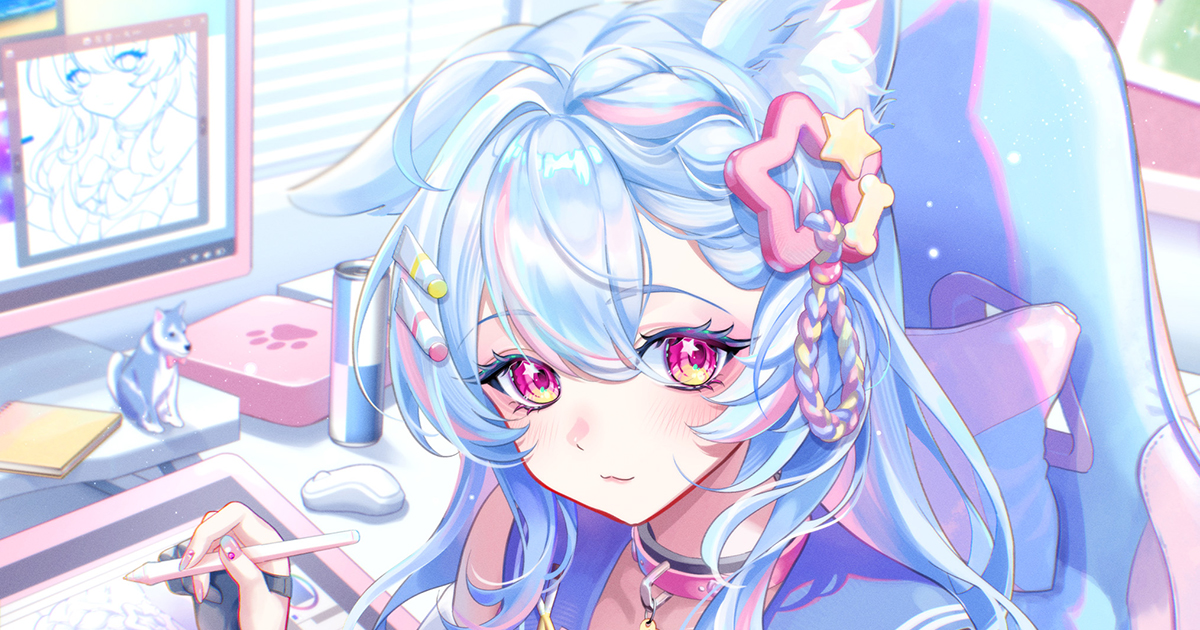
As an example, let’s look at my own original character.
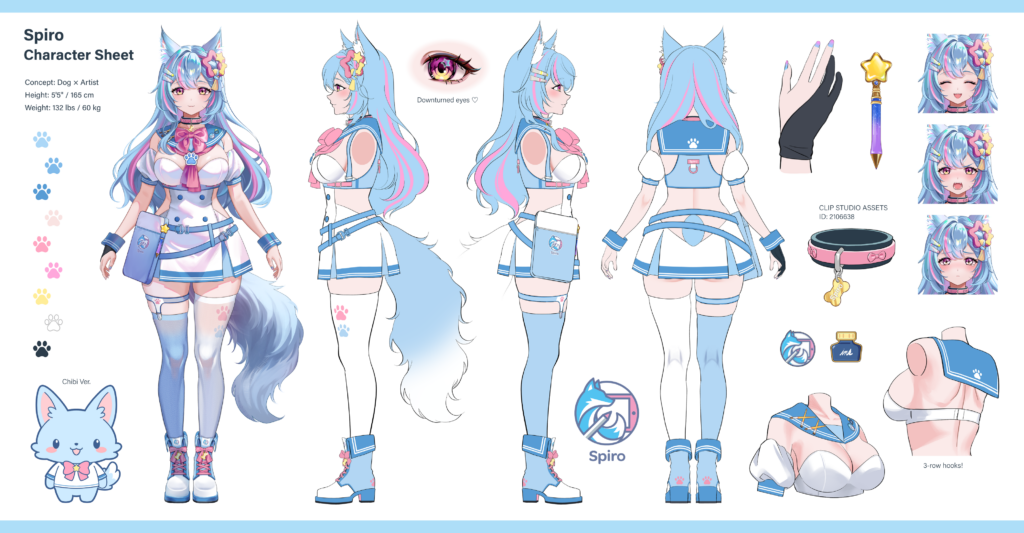
The main concepts are:
- Light blue as the main color, with some pink accents
- Sailor-style clothing
- Dog motif
- She is an artist
Of course, the full design contains many more details than this.
However, once the main features are clear, the artist has a strong foundation to work from and can organize the rest of the design around those priorities.
4. Include Reference Images
Reference images can be extremely useful for things that are difficult to explain with words alone.
For example, you might send:
“This is the kind of hairstyle I like.”
“I like the silhouette of this outfit.”
“I want an accessory with this kind of feeling.”
It is especially helpful to explain exactly which part of each reference image you want the artist to look at.
However, simply combining many different reference images can sometimes make the final design feel inconsistent.
Because of that, it is often better to let the artist make the final adjustments so that all of the elements work together as one character.
5. Treat Color Codes as Reference Colors
If you already have specific colors in mind, including color codes can be useful for communicating your preferences.
However, I recommend treating color codes as reference colors rather than strict requirements that must be reproduced exactly in the final illustration.
Illustrators often adjust hue, saturation, and brightness while considering the balance between the skin, hair, clothing, lighting, materials, and overall readability of the design.
A single base color may also become several different colors once highlights, shadows, and reflected light are added.
For that reason, it is usually better to communicate the general direction of the colors you want, while allowing the artist some freedom to make small adjustments.
This often results in a more harmonious final design.
6. Leave Live2D PSD Layer Separation to the Professionals
In most cases, the client does not need to specify the exact layer structure of the Live2D PSD.
The best way to separate the hair, eyes, mouth, body, clothing, and other parts depends on the character design and on how the rigger plans to animate the model.
Because of this, it is usually smoother to leave the technical layer separation to the illustrator and rigger.
If additional parts or corrections become necessary during production or rigging, sometimes the illustrator will handle them, and sometimes the rigger may be able to handle them.
Either way, additional work may involve an extra fee, so it is a good idea to confirm this in advance.
7. Help the Project Stay on Schedule
Live2D production often happens in stages.
For example, the illustrator may need to finish the model art before the rigger can begin their work.
If one stage is delayed, it can affect the entire schedule.
If the model artwork is delivered later than expected, the rigging process may also need to start later.
When choosing an artist, it is a good idea to look at their previous work and communication history and choose someone who is reliable with deadlines and communication.
The client also plays an important role in keeping the project moving smoothly.
For example:
- Reply to feedback requests as promptly as possible
- Give clear and specific revision instructions
- Avoid making major changes to the overall direction halfway through production
A smooth project depends on cooperation between the client, illustrator, and rigger.
8. The Final Result Will Not Be 100% Identical to the Image in Your Head
When commissioning an illustration or character design, it is important to understand that the final result will probably not match the image in your head perfectly.
The client communicates their ideas through words and reference images, and the artist interprets those ideas and turns them into artwork.
Because of that, even the most detailed design brief will still be filtered through the artist’s own interpretation, sensibilities, strengths, and artistic style.
I am an artist myself, but I also commission other artists and outsource parts of my own work from time to time.
Even then, the final result is rarely exactly the same as what I imagined in my head.
Of course, if something clearly differs from what was agreed upon, or if an essential element you specifically requested is missing, it is completely reasonable to ask for a correction.
However, small differences that come from the artist’s style or interpretation are not necessarily mistakes.
Sometimes it is helpful to think:
“It’s a little different from what I imagined, but this is beautiful in its own way.”
Being able to enjoy those differences can make commissioning artists a much more positive experience.
One of the best parts of working with another artist is discovering ideas, expressions, and interpretations that you might never have thought of yourself.
Communicate the parts that are truly essential to you, and leave a little room for the artist everywhere else.
That balance often leads to a smoother collaboration and a stronger final character design.
If you’re looking for a reliable illustrator who understands VTuber needs, feel free to check out my commission page.